World Heritage Site
Lamu Old Town

"Lamu Old Town" was added to Unesco's World Heritage List in 2001.
Brief description by UNESCO: Lamu Old Town is the oldestand best-preserved
Swahili settlement in East Africa, retaining its traditional functions. Built in coral
stone and mangrove timber, the town is characterized by the simplicity of structural forms
enriched by such features as inner courtyards, verandahs, and elaborately arved wooden doors.
Owing to the conservative character of its Muslim community, Lamu has hosted
major religious festivals since the nineteenth century, and has become a significant centre
for the study of Islamic and Swahili cultures.
Lamu Old Town
Justification for Inscription:
riterion (ii)The architecture and urban structure Lamu graphically
demonstrate the cultural influences that have come together there over several hundred years
from Europe, Arabia, and India, utilizing traditional Swahili techniques to produce a distinct
culture.
Criterion (iv) The growth and decline of the seaports the East African coast
and interaction between the Bantu, Arabs, Persians, Indians, and Europeans represents significant
cultural and economic phase in the history the region which finds its most outstanding
expression Lamu Old Town.
Criterion (vi) Its paramount trading role and its attraction for scholars
and teachers gave Lamu an important religious function in the region. It continues to be
significant centre for education in Islamic and Swahili culture.
Report of the 25th Session of the Committee
Brief description:
Lamu Old Town is the oldest and best-preserved Swahili settlement in East
Africa, retaining its traditional functions. Built in coral stone and mangrove timber, the
town is characterized by the simplicity of structural forms enriched by such features as inner
courtyards, verandas, and elaborately carved wooden doors.
Lamu has hosted major Muslim religious festivals since the 19th century,
and has become a significant centre for the study of Islamic and Swahili cultures.
Source: United Nations Educational, Scientific, Cultural Organisation-UNESCO
Lamu
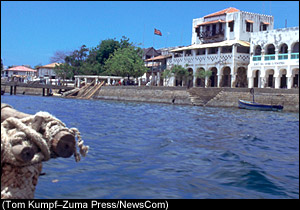
"Lamu is a place of fantasy and other-worldliness wrapped in a cloak of
medieval romance. With an almost exclusively Muslim population, Kenya's
oldest living town has changed little in appearance or character over many
centuries. Remote and self-contained, this once thriving port town is now
a gloriously relaxed and relaxing destination. No other Swahili town,
other than Zanzibar, can offer you such a cultural feast and uncorrupted
traditional style of architecture - if you can ignore the TV aerials. A
couple of hours spent in the waterfront Lamu Museum is an excellent
introduction to the town's culture and history. And if the museum stokes
your interest in Swahili culture then you should also check out the
beautifully restored building nearby housing the Swahili House Museum. One
of Lamu's quirkier attractions is the Donkey Sanctuary - no doubt a haven
for all those donkeys seeking political asylum. Taking a trip by dhow is
almost obligatory.
Nestled away on Lamu Island on Kenya's upper east coast, Lamu itself is
reached by diesel-powered launch from Mokowe on the mainland, or there's
an airport on nearby Manda Island."
Source:Cultural Heritage - Museum in Nairobi and Mombasa
We appeal for your donation for our charity
Comments and suggestions to improve this website
Your suggestions or concerns about our services
Please send you contributions by filling a form.
Copyright© March 2003: The Waswahili Community Trust (UK)
Registered Charity:1083065
Back to top
|