The Waswahili Community Trust UK
(Wadhamini wa jumuiya ya Waswahili)
|
|
The Waswahili Community Trust UK |
|

There is a good deal of historical evidence to show that the Swahilis have settled in the coast of Africa for about two thousands years, according to a book - "People of the Coast: Swahilis by Ahmed I Salim.
And in another book titled -"The Old Town Mombasa" A Historical Guide by J Maitland which stated that: Al Idrisi, the Arab geographer was the first to mention the town of Mombasa by name, when writing in 1154.
But there are also references to Swahili trading towns on the Coast of Africa such as Gedi, Pate,Kilwa,Amu(Lamu),Mombasa, and many others dating back to the second century.
It is also undesputed historical fact that the East Coast of Africa has had contact with the maritime Indian, and the Red Sea Civilisation many centuries before the advent of Islam.
The anonymous Greek traveller recorded in his periplus of the Erythrean Sea, written in the first century A.D.that he has seen trade being carried out between the local inhabitants of the East Coast settlements and Arab merchants."
Another account of East African trade is by Rhandall L Powell (1987) he notes the three phases in the development of Coastal seettlements. The first phase (800-1100). The second phase (1100-1300). Powells considers the third phase (1300-1600) as the Golden Age of Coastal history,civilistion,and economic prosperity.
On the other hand Mark Horton in his paper, at the University of Nairobi in 1990, which was based on his archeological work at Shanga (Pate island) in which he said Coastal trade depended upon a well organised entrepot system of exchange.
This according to him led to the coastal network of trade extending from the Somali coast to Southern Africa, what Horton calls "the Swahili corridor".
As early as the 6th century B.C. there has been the Swahili trading towns along the East African Coast which became powerful city states. However in another account the records shows that, there has been strong trading links between Zimbabwe and the Swahilis in the the 6th century, where the Swahilis fetched gold and ivories from the interior in exchange for the cotton, textiles and some other imported goods - The Struggle for Africa - Mai Palmberg
On the same note Ibn Batuta, the famous geographical traveller wrote in the fourteenth century, in which he referred specifically to his trip to "the land of the Swahili." - The Swahili Idiom and Identity of an African people - Alamin M Mazrui and Ibrahim Noor Shariff.
The foundation for a small scale domestic industrial development was also firmly established in the East Coast of Africa. This fact was demonstrated by a high level of economic activities in the region. For example, in the Fifteenth century, spices, gold, and ivory were traded for cotton.
It was also the case that iron ore was mined in Tanzania, and Mombasa was famous for the manufacturing of ivory inlaid daggers. It is difficult, therefore, to avoid the conclusion that the Portuguese colonial expansion in the East Coast of Africa, of which we are now going going to consider was the beginning of the European colonial powers to destroy the very foundation of Swahili economic development, and its domestic industries.
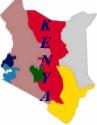
In 1498 a Portuguese fleet board for India and commanded by Vasco da Gama called at Mombasa, but the explorers found the inhabitants too hostile. So they sailed on, and landed in Malindi, where a base was established, and where they formed an informal, and unholy alliance with Malindi people (see the map for its location).
This unholy alliance was also joined by Segeju, and the Zimba tribe, all of whom were Kogowea's (Mombasa) immediate rival. As the Spanish crusaders, could defeat the American'Aztec and Inca Empire, only by dividing them, the same strategy was employed by the Portuguese in Mombsa. The town of Mombasa was attecked by the Portuguese and their alliance in 1505, 1528, and 1589.
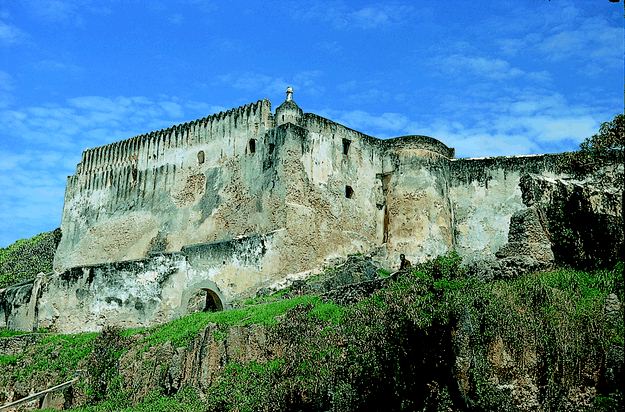
In their most celebrated book cited above, Alamin documented the Portuguese brutality, and genocide in Mombasa, in this they commented:"The Portuguese subjected the Swahili people to some of the most heinous brutality ever experienced in the history of East Africa," and they added:"It was like a repeat of the crusader, but on a small scale."However, Mombasa sshowed a militant resistance, and deservedly it earned the name of "Mvita" which is the Swahili name referring to the people of Mombsasa as fighters. The three generations of uprisings finally led to success in 1698, when a joint army of Mombasa "Wamvita" with the army besieged, and took control of the most heated stronghold of "Fort Jesus", which the Portuguese had built for their defence.
But the cost of resistance was incalculable, because, the records of the time shows that "they had killed every living thing they found, men, women, and children, even down to the household dogs and parrots", writes Davidson (1969:115).
And he added:"the Portuguese almost at once began to loot and burn. They broke into city after city, sacking and stealing" (1991:193). But they m et with militant resistance at various points. It is also without any doubt that the Portuguese colonialism acted as a severe blow in the evolutionary process towards Swahili nationhood, and Swahili unification.
Therefore, what L Powell's referred to above as the period of the "Golden Age of Coastal History, Civilisation, and Economic prosperity" was not given time to consolidate itself. Therefore, the conclusion cannot be avoided that, this historical experience was killed at birth, in order to perpetuate colonial occupation and its interests, and also at the same time to subjugate the Swahili people of Mombasa.
However, it can be argued that with very good justification that, as the Mau Mau freedom fighters led a war of liberation in Kenya against the British colonialism in the twentieth century, the Swahili people, on the other hand, were the freedom fighters of the fifteenth century. It is the heroic resistance of the Swahilis that has acted as a barrier against the Portuguese Imperial expansion in the region.
But, also the greater negative impact of the Portuguese invaders was the disintegration of the Swahilis, an d the effect of which has survived to our present time.
We appeal for your donation for our charity
Comments and suggestions to improve this website
Your suggestions or concerns about our services
Please send you contributions.
Copyright© March 2003: The Waswahili Community Trust (UK)
Registered Charity:1083065